 100-day satisfaction guarantee*
Digestion turns food into smaller components that the body can absorb. Enzymes help carry out that work. Understanding which enzyme acts on which food component makes supplement labels easier to interpret and helps explain why one product cannot do every job.
Follow the food through digestion
Digestive activity starts in the mouth and continues through the stomach and small intestine. Several organs contribute; the pancreas is an important source of enzymes delivered to the small intestine. Enzymes act alongside the physical mixing and movement of food.
Different enzymes have different targets. Amylase helps break down starch, proteases act on proteins and lipase acts on fats. Lactase breaks lactose into glucose and galactose. Sucrase acts on sucrose. Johns Hopkins explains digestive enzymes and supplements.
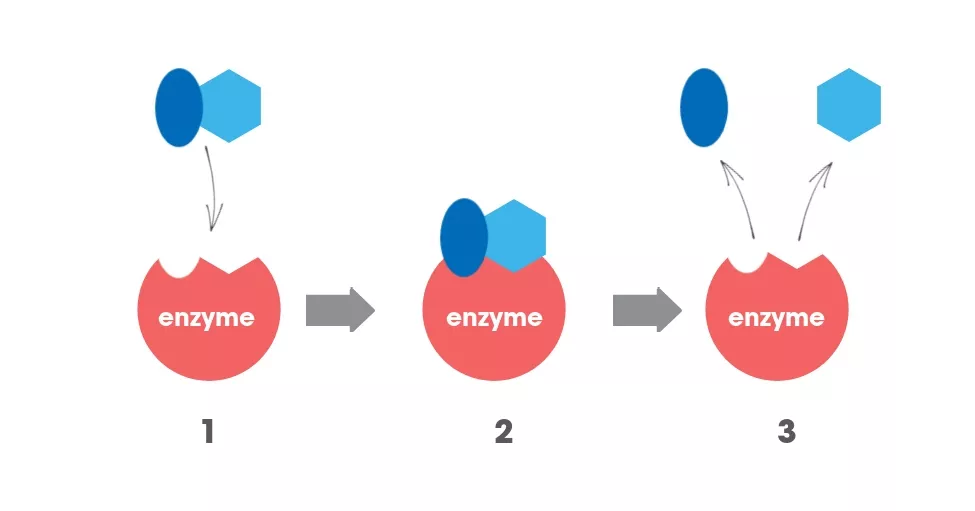
Why the “lock and key” comparison is useful
An enzyme’s structure helps it interact with a particular substance, often called its substrate. The lock-and-key comparison is a simple way to picture that selectivity. It explains why lactase is used for lactose, rather than as a general answer to any discomfort after a meal.
A combination supplement may include several ingredients intended for different food components. It still has a defined formulation and purpose. More enzymes on a label do not automatically make a product the right choice for a particular person.
When food intolerance enters the picture
If there is not enough lactase to digest the lactose eaten, some lactose can reach the large intestine and contribute to symptoms. This is one example of an intolerance associated with an enzyme shortage.
It is not a model for every food-related symptom. Some difficulties involve absorption, and humans do not naturally make an enzyme for every carbohydrate in food. Nor is a food allergy simply a shortage of digestive enzymes. Read our guide to the difference between allergy and intolerance before assuming the two can be managed in the same way.
How to read an enzyme product label
- Target: identify the food component the product is intended to act on.
- Activity: compare the stated enzyme activity and serving directions, rather than capsule count alone.
- Timing: check whether the product is taken with food or used during food preparation.
- Other ingredients: read the capsule material and excipients as well as the active ingredient.
The original article used a lactase capsule containing lactase, calcium carbonate and HPMC as an example of a straightforward formulation. Check the current pack, as that example does not describe every enzyme product or format.
Choose by purpose, then follow the directions
A tablet taken at a meal and drops used to prepare dairy have different instructions. There is no single timing window that should be assumed for all products. Follow the directions on the Australian pack, including any advice on storage and suitable food types.
Our lactose product collection provides examples of the available formats. If symptoms are persistent, unexplained or changing, seek assessment rather than relying on supplements to work out the cause.