 100-day satisfaction guarantee*
Ideas for everyday eating
Polyols on food labels: sorbitol, mannitol and other sugar alcohols
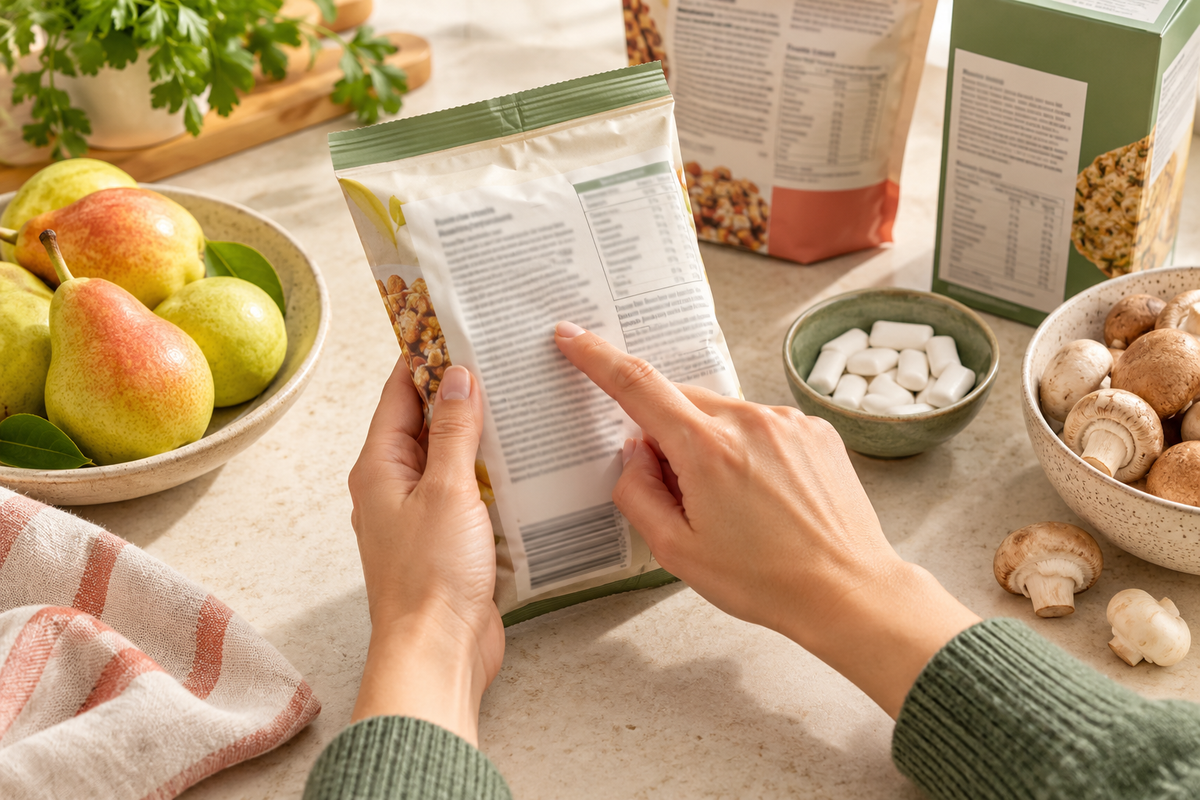
Polyols are a family of carbohydrates often called sugar alcohols. They occur naturally in some fruit and vegetables and are also used as sweeteners in products such as sugar-free chewing gum, mints, confectionery and some protein snacks. If polyols are relevant to your digestive symptoms, the ingredient list is a useful place to start—but it needs to be read alongside serving size and your individual tolerance.
What are polyols?
Sorbitol and mannitol are two polyols commonly discussed in the FODMAP framework. Monash University explains that they can be absorbed incompletely in the small intestine and may contribute to symptoms in people who are sensitive to them. That does not mean every food containing a polyol will affect every person in the same way.
Polyols are not the same as drinking alcohol, and the word “sugar” in sugar alcohol does not mean they behave exactly like table sugar.
Names you may see on an ingredient list
On Australian packaged foods, additives generally appear by their class name followed by the additive name or number. Polyol sweeteners you may encounter include:
- sorbitol or 420
- mannitol or 421
- isomalt or 953
- maltitol or 965
- lactitol or 966
- xylitol or 967
- erythritol or 968
Monash University’s FODMAP label-reading guide lists these names and numbers. Food Standards Australia New Zealand also explains how food additives are declared on labels.
“Sugar-free” is not the same as “polyol-free”
A sugar-free claim tells you something about sugars; it does not automatically tell you whether a product contains polyol sweeteners. Check the full ingredient list rather than relying on the front of the pack. Products such as chewing gum, mints and confectionery are common places to find added polyols, but formulations can change.
Some foods containing specified polyols must carry an advisory statement to the effect that excess consumption may have a laxative effect. The current requirement is set out in Standard 1.2.3 of the Australia New Zealand Food Standards Code. Treat that statement as a prompt to check the ingredients and portion—not as a diagnosis or a complete guide to FODMAP content.
Natural sources still count
An ingredient list only describes what has been added to a packaged product. Polyols can also occur naturally in whole foods. For example, some fruits contain sorbitol and some vegetables contain mannitol. The type and amount can vary, so a long “foods to avoid” list is less useful than current tested serving information and a structured personalisation process.
A practical five-step label check
- Read the whole ingredient list. Look for both names and additive numbers.
- Check the serving information. The effect of a small serve may differ from that of several serves eaten together.
- Notice combinations. A product can contain more than one FODMAP source, so polyols may not be the only relevant ingredient.
- Keep the rest of the meal in view. Several foods eaten close together can change the total amount consumed.
- Record what actually happened. A brief food and symptom diary can be more informative than avoiding every product with a particular word.
Do you need to avoid every polyol?
Not necessarily. A structured low-FODMAP approach is intended to identify which groups and amounts are relevant to the individual, then broaden the diet as far as possible. Monash’s current three-step approach challenges sorbitol and mannitol separately during reintroduction. Read our guide to reintroduction and personalisation for a practical overview.
Healthdirect notes that a low-FODMAP diet can help people with diagnosed IBS explore food triggers, but it can be complex and should be undertaken with professional support. If symptoms are persistent, severe, new, or leading to a very restricted diet, speak with your GP and an Accredited Practising Dietitian rather than self-diagnosing.
Keep label reading useful
The goal is not to fear every unfamiliar ingredient. Use the label to identify likely polyol sources, compare products and test your own tolerance methodically. Recheck labels when you repurchase because recipes can change, and use current serving information from a qualified source when you follow a structured FODMAP plan.
For more practical reading, see Healthdirect’s low-FODMAP guidance or browse our food-intolerance-friendly recipe collection.